


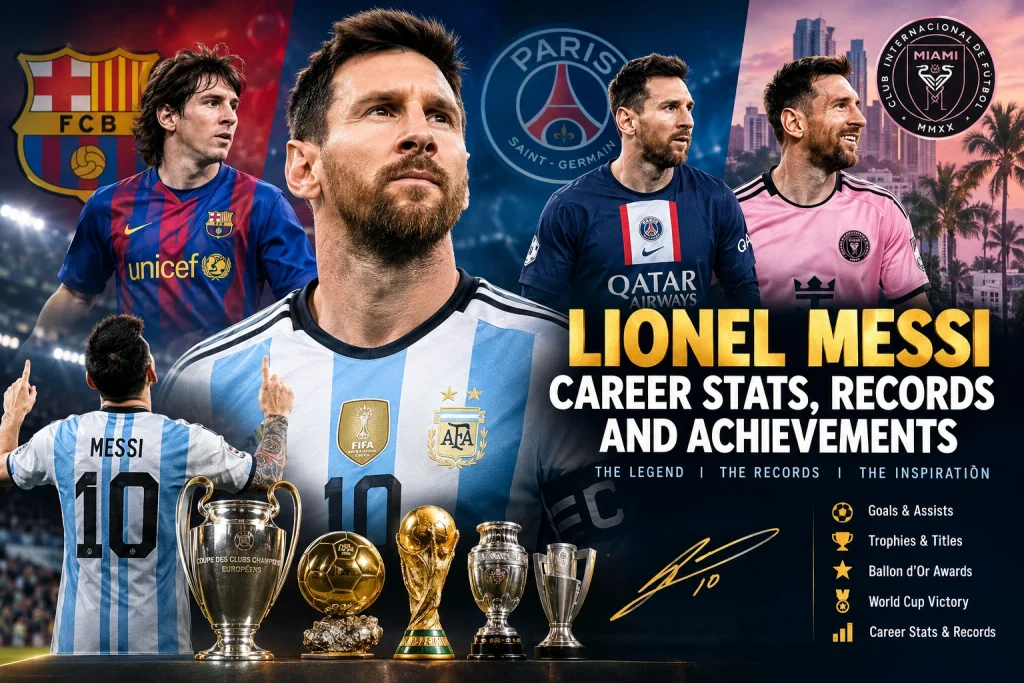
Introduction: Why Lionel Messi’s Career Stands Apart
Lionel Messi has built one of the most remarkable careers in football history. His goals, assists, trophies, individual awards, and performances for Argentina have shaped an extraordinary sporting legacy. From his early days at Barcelona to his achievements with Inter Miami, Messi has continued to influence football across generations.
The story behind Lionel Messi Career Stats, Records and Achievements goes beyond scoring goals. We see a player who combines exceptional close control, precise passing, creative vision, intelligent movement, and remarkable consistency. He can change a match with a single pass or finish a difficult chance with stunning accuracy.
Messi’s journey also includes important milestones with the Argentina national team. His Copa América victories and the 2022 FIFA World Cup triumph completed a major chapter in his international career.
This comprehensive guide explores his club statistics, international achievements, major trophies, individual honours, and historic records. We also examine the qualities that make Messi such a special player and explain how his career developed across different leagues and competitions.
1. Lionel Messi: Player Profile and Career Overview
Lionel Andrés Messi was born on June 24, 1987, in Rosario, Argentina. He developed his football skills at a young age and joined Barcelona’s youth system as a teenager. His technical ability and natural creativity helped him progress through the club’s development structure.
Messi made his first-team debut for Barcelona in October 2004. He gradually became one of the team’s most influential players, forming productive partnerships with several world-class forwards and midfielders. His performances helped Barcelona win major domestic and European competitions.
In 2021, Messi left Barcelona and joined Paris Saint-Germain. He spent two seasons in France before moving to Inter Miami in 2023. His arrival increased international attention on Major League Soccer and gave the American club a world-famous attacking leader.
Messi has also enjoyed an outstanding international career with Argentina. He won the FIFA World Cup in 2022, lifted the Copa América in 2021 and 2024, and earned the Olympic gold medal in 2008.
The key facts behind Lionel Messi Career Stats, Records and Achievements show how he has succeeded in different football environments. His career combines individual excellence, team success, and sustained performance at the highest level.
2. Lionel Messi Career Stats: Goals, Assists, and Appearances
Messi’s career statistics reflect his ability to influence matches in several ways. He scores from open play, converts free kicks, creates opportunities for teammates, and contributes to attacking moves through intelligent passing.
His Barcelona record provides a major part of his statistical legacy. According to Major League Soccer’s historical coverage, Messi scored 672 goals in 778 appearances for Barcelona’s first team. Those figures established him as the club’s all-time leading goalscorer.
Messi also scored 32 goals in 75 appearances for Paris Saint-Germain. His production continued after his move to Inter Miami, where he reached 100 goals across all competitions in 115 appearances by September 2026, according to the club.
Internationally, Messi became Argentina’s all-time leading men’s goalscorer. His national-team career features major tournament goals, assists, and performances in World Cup and Copa América competitions.
We should distinguish official senior appearances from youth matches and exhibition games when comparing career statistics. Assist totals can also vary among statistical providers because different competitions and historical records use different definitions.
For the latest figures, consult MLS’s Messi statistics page and the official club reports. These sources help readers follow his evolving numbers without mixing league-only statistics with totals from every competition.
3. Lionel Messi’s Barcelona Career: The Foundation of a Legend
Barcelona played a central role in Messi’s development. He joined the club’s youth academy, La Masia, and progressed into the senior team during the 2004–05 season. His early performances revealed a rare combination of balance, acceleration, close control, and attacking intelligence.
Messi gradually became the centre of Barcelona’s attacking system. He operated as a winger, a forward, and a creative playmaker. His ability to move into central areas made him difficult for defenders to track.
During his Barcelona career, Messi won 10 La Liga titles, four UEFA Champions League titles, and seven Copa del Rey trophies. He also won eight Spanish Super Cups, three UEFA Super Cups, and three FIFA Club World Cups with the club.
His relationship with teammates played an important role in these successes. Partnerships with players such as Xavi Hernández, Andrés Iniesta, and Luis Suárez helped Barcelona produce some of the most memorable attacking football of the modern era.
Messi’s individual statistics also set him apart. His 672 Barcelona goals remain a defining achievement, while his performances in El Clásico strengthened his reputation in one of football’s biggest rivalries.
The Barcelona chapter of Lionel Messi Career Stats, Records and Achievements demonstrates how long-term development, tactical intelligence, and elite finishing can combine to create a historic club career.
4. Paris Saint-Germain: A New Challenge in France
Messi joined Paris Saint-Germain in August 2021 after Barcelona could not complete his registration under the club’s financial and regulatory circumstances. The move marked a major change after more than two decades within Barcelona’s football system.
At PSG, Messi adapted to a different league, tactical structure, and group of teammates. He played alongside Kylian Mbappé and Neymar, creating an attack that attracted global attention.
Messi scored 32 goals in 75 appearances for PSG. His contributions included goals and assists in Ligue 1 and European competition. He also demonstrated his creative value through passing, chance creation, and combinations with other forwards.
He won two French Ligue 1 titles during his time at the club. He also lifted the Trophée des Champions in the 2022–23 campaign.
His PSG spell differed from his Barcelona years. He often played a more creative role, linking midfield and attack while helping teammates enter scoring positions. His performances showed that his influence did not depend only on speed or direct dribbling.
The Paris chapter adds an important dimension to Lionel Messi Career Stats, Records and Achievements. It illustrates his ability to adapt to a new club, contribute to domestic success, and maintain his attacking influence in a different football environment.
5. Inter Miami: Messi’s Impact on American Soccer
Messi joined Inter Miami in 2023, bringing enormous global attention to Major League Soccer. His arrival helped increase interest in the club, its matches, and professional soccer across the United States.
He made an immediate impact by leading Inter Miami to the 2023 Leagues Cup title. The tournament marked the club’s first major trophy. Messi scored crucial goals throughout the competition and helped transform the team’s attacking confidence.
In 2024, Inter Miami won the MLS Supporters’ Shield. Messi contributed heavily to the club’s outstanding regular-season campaign and earned the league’s Most Valuable Player award.
His influence continued in 2025. Inter Miami won MLS Cup, and Messi claimed the MLS MVP award for a second consecutive season. He also won the MLS Golden Boot with 29 regular-season goals and recorded 19 assists that season.
By September 2026, Inter Miami confirmed that Messi had scored 100 goals across all competitions for the club in 115 appearances. He became the first player in the club’s history to reach that milestone.
These achievements form a major part of the modern Lionel Messi Career Stats, Records and Achievements story. His performances have delivered trophies and individual honours while helping Inter Miami build a stronger international profile.
6. Lionel Messi’s Argentina Career and International Goals
Messi’s Argentina career has included triumphs, difficult defeats, and a remarkable period of international success. He made his senior debut in 2005 and gradually became the national team’s central attacking figure.
Argentina reached the 2014 FIFA World Cup final but lost to Germany. Messi won the tournament’s Golden Ball as its outstanding player. The defeat left a painful memory, yet it did not end his ambition to win a major senior international trophy.
Argentina finally won the 2021 Copa América, defeating Brazil in the final at the Maracanã. The victory gave Messi his first major senior international title with Argentina and marked an important moment in his career.
He then helped Argentina win the 2022 FIFA World Cup in Qatar. Messi scored seven goals during the tournament and won another Golden Ball. Argentina defeated France in a dramatic final decided by a penalty shootout.
In 2024, Argentina won a second consecutive Copa América title. Messi’s contribution to the national team extended beyond goals, as he also created chances, controlled attacking transitions, and guided teammates through high-pressure matches.
His international achievements transformed the conversation around his legacy. The Argentina chapter of Lionel Messi Career Stats, Records and Achievements shows how persistence and sustained excellence helped him reach the summit of international football.
7. Lionel Messi’s FIFA World Cup Records and Achievements
The FIFA World Cup represents the highest stage in international men’s football. Messi appeared in multiple editions of the tournament and became one of its most influential players.
His first World Cup appearance came in 2006. Over subsequent tournaments, he developed from a young attacking talent into Argentina’s experienced leader.
The 2014 tournament brought Messi the Golden Ball despite Argentina’s defeat in the final. His performances throughout the competition helped Argentina reach the championship match.
The 2022 World Cup provided the defining achievement of his international career. Messi scored in the group stage, knockout rounds, and final. His performances helped Argentina defeat France after a thrilling match and a penalty shootout.
Messi became the first player to win the World Cup Golden Ball twice, receiving the award in 2014 and 2022. This record reflects his influence across two different stages of his career.
His World Cup story also highlights his ability to handle pressure. He scored important penalties, created attacking opportunities, and contributed to Argentina’s collective defensive effort when needed.
The tournament records within Lionel Messi Career Stats, Records and Achievements demonstrate his lasting importance to Argentina and the global game.
8. Lionel Messi’s Copa América Titles and International Honours
The Copa América has provided another major stage for Messi’s international achievements. The competition brings together South America’s leading national teams and often features intense, physically demanding matches.
Argentina reached the final in 2015 and 2016 but lost both tournaments. Those defeats created difficult moments for Messi and the national team. Argentina’s eventual success made the later victories especially meaningful.
In 2021, Argentina defeated Brazil 1–0 in the final. Messi contributed throughout the tournament with goals, assists, and creative play. The title ended Argentina’s long wait for a major senior men’s international trophy.
Argentina retained the title in 2024. The team defeated Colombia in the final, extending a successful era under coach Lionel Scaloni. Messi suffered an injury during the final but celebrated another major international triumph with his teammates.
Messi also won the 2005 FIFA Under-20 World Cup and the gold medal at the 2008 Beijing Olympic Games. These achievements demonstrate his success across different stages of international football.
The international honours in Lionel Messi Career Stats, Records and Achievements reflect both individual quality and team success. His medals and tournament performances have secured a prominent place in Argentina’s football history.
9. Lionel Messi’s Eight Ballon d’Or Awards
The Ballon d’Or recognises outstanding individual performance in men’s football. Messi has won the award eight times, more than any other player in the award’s history.
His victories came in 2009, 2010, 2011, 2012, 2015, 2019, 2021, and 2023. These awards span different teams, tactical systems, and stages of his career.
The four consecutive wins from 2009 through 2012 highlighted an extraordinary period of individual excellence. Messi combined high goal totals with creativity, dribbling, and consistent performances for Barcelona.
His 2015 award followed another successful season in which Barcelona won major trophies. The 2019 award recognised his continued influence at club level, while the 2021 award came after his Copa América triumph with Argentina.
The 2023 Ballon d’Or reflected the importance of his World Cup-winning campaign in Qatar. His leadership and performances helped Argentina secure the trophy that had eluded him for much of his international career.
Messi’s Ballon d’Or record remains one of the most recognisable achievements in modern football. It forms a central part of Lionel Messi Career Stats, Records and Achievements and provides a useful measure of his sustained excellence.
10. Lionel Messi’s European Golden Shoes and Scoring Records
Messi’s goalscoring ability has earned him several major individual awards. He won the European Golden Shoe six times, recognising his outstanding league goalscoring performances across European football.
He also won La Liga’s Pichichi Trophy eight times as the league’s leading goalscorer. These achievements demonstrate his ability to score consistently against different defensive systems and opponents.
One of Messi’s most remarkable domestic records came during the 2011–12 season. He scored 50 goals in La Liga, setting a single-season scoring record for the competition.
His goals came from several situations. He scored with close-range finishes, powerful strikes, curling shots, penalties, and free kicks. His quick changes of direction often created the space needed to take a shot.
Messi also combined goalscoring with playmaking. His passing vision allowed him to create opportunities when defenders focused on blocking his shooting lanes.
These records explain why Messi’s attacking influence extends beyond a single statistic. The combination of goals, assists, chance creation, and consistency makes his career especially impressive.
The scoring milestones within Lionel Messi Career Stats, Records and Achievements offer a clear picture of a player who repeatedly delivered at the highest level over many seasons.
11. Lionel Messi’s Free-Kick Goals and Technique
Messi’s free-kick ability has become one of the most recognisable parts of his game. He combines precise ball placement, controlled power, and a consistent striking technique to score from difficult positions.
His approach often involves studying the goalkeeper’s position and identifying gaps in the defensive wall. He can bend the ball over the wall, curl it around the defenders, or strike toward the far post.
Messi’s technique depends on more than his left foot. His balance, approach angle, body position, and ability to control the strike all influence the final result. He also changes his placement depending on the distance and angle.
Free kicks provide another way for Messi to influence matches when opponents defend deep. Even when he does not score, his set-piece delivery can create dangerous chances for teammates.
His free-kick record also highlights his technical development. Over time, he became a more reliable specialist who could deliver in high-pressure league matches and international tournaments.
When we examine Lionel Messi Career Stats, Records and Achievements, his set-piece ability deserves special attention. It adds another dimension to his scoring record and shows how technical precision can remain valuable throughout a long career.
12. Lionel Messi’s Assists and Playmaking Records
Messi’s career cannot be measured by goals alone. His passing vision and playmaking ability have helped teammates score across domestic leagues, European competitions, and international tournaments.
He often creates chances by attracting multiple defenders before releasing a perfectly timed pass. His low centre of gravity and close control allow him to move into crowded spaces while keeping the ball under control.
Messi can deliver through balls between defenders, switch play toward the opposite wing, or use short combinations near the penalty area. He also creates opportunities from free kicks, corners, and quick counterattacks.
His partnership with Barcelona’s midfielders helped establish a style built around movement and possession. Later, his combinations with forwards at PSG, Inter Miami, and Argentina showed that his passing ability could adapt to different teammates.
Assist statistics can vary between databases because providers apply different rules when recording the final pass before a goal. Readers should therefore use a consistent source when comparing players or seasons.
The playmaking side of Lionel Messi Career Stats, Records and Achievements explains why his influence extends far beyond finishing. His ability to create chances makes him both a prolific scorer and an exceptional attacking organiser.
13. Lionel Messi’s Champions League Records
The UEFA Champions League has provided a major stage for Messi’s greatest club performances. He won the competition four times with Barcelona, lifting the trophy in 2006, 2009, 2011, and 2015.
His Champions League performances included memorable goals against leading European clubs. He regularly challenged elite defenders with close control, quick combinations, and precise finishing.
Messi also won the Champions League top-scorer award in multiple seasons. His performances helped Barcelona establish itself as one of Europe’s leading teams during his peak years.
The competition tested his abilities against different tactical systems. Some opponents pressed high, while others defended deep and tried to limit space near the penalty area. Messi often found solutions through movement, passing, or individual skill.
His success in the tournament remains an important part of his club legacy. Although his career later moved beyond European football, his Barcelona achievements continue to shape discussions about the greatest Champions League players.
For readers exploring Lionel Messi Career Stats, Records and Achievements, the Champions League record provides a useful measure of his impact against Europe’s strongest opponents.
14. Lionel Messi’s El Clásico Records Against Real Madrid
El Clásico, the rivalry between Barcelona and Real Madrid, has produced many memorable matches. Messi became one of its defining figures through his goals, assists, and influential performances.
He scored 26 goals in official El Clásico matches, making him the fixture’s all-time leading goalscorer according to widely reported historical records. His performances included goals at the Santiago Bernabéu and Camp Nou.
One of his most memorable moments came in April 2017. Messi scored a late winner against Real Madrid and celebrated by holding his Barcelona shirt in front of the home crowd.
That moment became one of the most widely remembered images in the rivalry’s modern history. It captured both the intensity of the occasion and Messi’s ability to deliver in high-pressure matches.
His success against Real Madrid involved more than finishing. He regularly dropped into midfield, created overloads, and helped Barcelona move the ball into dangerous areas.
El Clásico remains an important part of Lionel Messi Career Stats, Records and Achievements because it measures his performances in one of club football’s most demanding rivalries.
15. Lionel Messi’s Playing Style and Technical Strengths
Messi’s playing style combines close control, acceleration, vision, and decision-making. His ability to keep the ball near his feet makes it difficult for defenders to predict his next movement.
He frequently uses short touches and changes of direction to escape pressure. Rather than relying only on straight-line speed, he creates separation through timing, balance, and quick reactions.
His left foot allows him to produce accurate shots and passes from different angles. However, his creativity also depends on his awareness of teammates and his ability to recognise openings before they fully develop.
Messi can play as a right winger, a central forward, or a deeper attacking playmaker. Each role requires different movements, yet he consistently finds ways to influence the attack.
His understanding of space is particularly important. He often moves away from defenders before receiving the ball, allowing him to turn quickly and advance toward goal.
The technical qualities behind Lionel Messi Career Stats, Records and Achievements help explain his longevity. His game relies on skill, anticipation, and decision-making rather than physical power alone.
16. Lionel Messi’s Most Memorable Career Milestones
Messi’s career includes several milestones that shaped his legacy. His Barcelona debut in 2004 marked the beginning of a professional journey that would transform the club’s history.
His first Ballon d’Or in 2009 confirmed his status as one of football’s leading players. The following years brought more individual awards, domestic titles, and Champions League success.
The 2012 calendar year became another landmark. Messi scored 91 goals in official matches for club and country during that calendar year, a figure recognised by Guinness World Records.
His international career later reached new heights. Argentina’s Copa América victory in 2021 ended a long wait for a major senior title. The 2022 World Cup triumph then completed one of football’s most celebrated personal journeys.
His move to Inter Miami in 2023 introduced a new chapter. He won the Leagues Cup in his first season and helped the club achieve further success in the following years.
In September 2026, Inter Miami confirmed that Messi had reached 100 goals for the club across all competitions. This milestone demonstrated his continued scoring ability.
These moments form the timeline of Lionel Messi Career Stats, Records and Achievements, connecting his early development with his later international and club success.
17. Lionel Messi’s Major Trophies by Team
Messi’s trophy collection spans several clubs and the Argentina national team. Each stage added a different achievement to his career.
| Team | Major achievements |
|---|---|
| Barcelona | 10 La Liga titles, 4 Champions League titles, 7 Copa del Rey titles |
| Paris Saint-Germain | 2 Ligue 1 titles |
| Inter Miami | 2023 Leagues Cup, 2024 Supporters’ Shield, 2025 MLS Cup |
| Argentina senior team | 2021 and 2024 Copa América, 2022 FIFA World Cup, 2022 Finalissima |
| Argentina youth and Olympic teams | 2005 FIFA Under-20 World Cup, 2008 Olympic gold medal |
These honours represent different kinds of success. League titles require consistency across a long season, while cup competitions demand strong performances in decisive matches.
International tournaments bring another challenge because national teams have limited preparation time. Messi’s achievements with Argentina demonstrate his ability to contribute within a different tactical environment.
Readers should distinguish team trophies from individual awards when comparing career totals. Some databases count every official senior team trophy, while others use narrower definitions.
The trophy record remains one of the strongest elements of Lionel Messi Career Stats, Records and Achievements. It demonstrates sustained success across domestic leagues, international tournaments, and different stages of his professional career.
18. Lionel Messi’s Leadership and Influence on Teammates
Messi’s influence extends beyond individual statistics. His experience and decision-making have helped teammates operate more effectively in attacking situations.
At Barcelona, he developed partnerships that produced consistent attacking success. His movement created space for midfielders and forwards, while his passing helped teammates receive the ball in dangerous positions.
With Argentina, Messi gradually took on a greater leadership role. He helped guide the team through difficult tournament campaigns and played a central role in its eventual international success.
His leadership does not always rely on constant instructions or dramatic gestures. Much of his influence comes through his movement, composure, and ability to make the right decision under pressure.
At Inter Miami, his presence has also brought increased attention to teammates and the club’s wider development. Playing alongside a globally recognised star can create opportunities for younger players to learn from his positioning, passing, and preparation.
The wider significance of Lionel Messi Career Stats, Records and Achievements includes this influence on team performance. Football rewards collective success, and Messi’s career shows how an elite attacker can elevate the players around him.
19. Lionel Messi vs Cristiano Ronaldo: Career Records Compared
The comparison between Messi and Cristiano Ronaldo remains one of football’s most popular debates. Both players have achieved extraordinary goalscoring records, won major trophies, and maintained elite performances across many seasons.
Messi is widely recognised for his close control, creative passing, dribbling, and playmaking. Ronaldo has built his reputation on powerful finishing, aerial ability, athleticism, and goalscoring across different leagues.
Messi has won eight Ballon d’Or awards. Ronaldo has won five. Messi also won the 2022 FIFA World Cup with Argentina, while Ronaldo won the European Championship with Portugal in 2016 and the UEFA Nations League in 2019 and 2025.
Their career goal totals change as they continue playing, and statistical providers sometimes classify appearances and assists differently. A fair comparison should use the same competition definitions and the same reporting date.
Neither player’s achievements can be reduced to one number. Their different strengths have influenced football and inspired millions of supporters around the world.
When evaluating Lionel Messi Career Stats, Records and Achievements, we should consider goals, assists, trophies, individual awards, and performances in major tournaments. This approach provides a fuller picture than relying on a single statistic.
20. Why Lionel Messi Remains a Football Icon
Messi’s legacy rests on a combination of individual excellence and team success. He has produced outstanding statistics, won major titles, and delivered memorable performances for both club and country.
His career also shows remarkable adaptation. He progressed from Barcelona’s youth academy to the senior team, succeeded in France, and continued producing important performances in American soccer.
His World Cup triumph with Argentina gave his international career a defining achievement. The Copa América titles and Olympic gold medal add further depth to his record.
Messi’s playing style has influenced young footballers who study his close control, movement, and passing. His ability to create space and make quick decisions offers valuable lessons for players at every level.
The combination of longevity, creativity, and consistency makes his career especially distinctive. He has succeeded in several roles and contributed to teams with different tactical approaches.
The full picture of Lionel Messi Career Stats, Records and Achievements shows why he remains a central figure in football history. His numbers tell one part of the story, while his trophies, performances, and influence complete the picture.
Frequently Asked Questions About Lionel Messi
1. How many goals did Lionel Messi score for Barcelona?
Messi scored 672 goals in 778 first-team appearances for Barcelona. This record makes him the club’s all-time leading goalscorer.
2. How many Ballon d’Or awards has Lionel Messi won?
Messi has won eight Ballon d’Or awards. He received them in 2009, 2010, 2011, 2012, 2015, 2019, 2021, and 2023.
3. Which major international trophies has Messi won with Argentina?
Messi has won the 2022 FIFA World Cup, the 2021 and 2024 Copa América titles, and the 2022 Finalissima. He also won the 2005 FIFA Under-20 World Cup and the 2008 Olympic gold medal with Argentina’s Olympic team.
4. How many goals has Messi scored for Inter Miami?
Inter Miami confirmed that Messi reached 100 goals across all competitions in 115 appearances on September 16, 2026. His total can change as he plays more matches.
5. How many Champions League titles has Messi won?
Messi won four UEFA Champions League titles with Barcelona. His victories came in 2006, 2009, 2011, and 2015.
Conclusion: Lionel Messi’s Extraordinary Football Legacy
The story of Lionel Messi Career Stats, Records and Achievements reflects one of the most successful careers in modern football. His 672 Barcelona goals, eight Ballon d’Or awards, four Champions League titles, and 2022 World Cup triumph demonstrate his exceptional ability and sustained success. His achievements at Paris Saint-Germain and Inter Miami further show his capacity to adapt to new teams and competitions. Beyond the statistics, Messi has influenced teammates, inspired young players, and created unforgettable moments for football fans around the world. His career stands as a powerful example of technical excellence, creativity, perseverance, and team achievement.

