


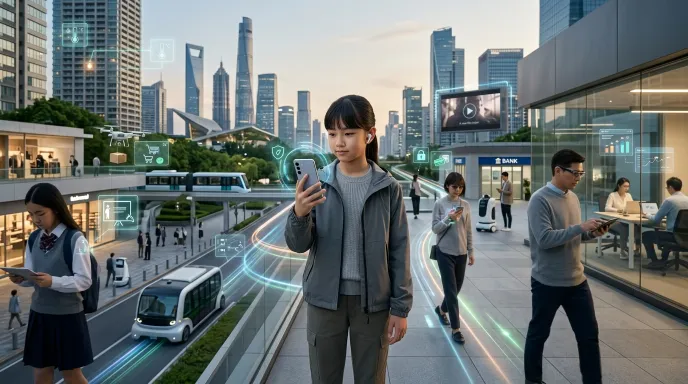
Artificial intelligence used to sound like something from a futuristic movie.
Today, it’s sitting inside the devices and services we use every day.
When your phone recognizes your face, when an app recommends a song, when Google helps complete a sentence, when an online store suggests a product or when a chatbot answers a question, there’s a good chance some form of artificial intelligence is working behind the scenes.
The interesting thing is that most people don’t even notice it anymore.
AI has quietly moved from research laboratories into our homes, workplaces, schools, cars and smartphones.
And in 2026, that transformation is becoming even more noticeable.
From the way we search for information to the way businesses communicate with customers, artificial intelligence is changing everyday life in ways that are both obvious and surprisingly subtle.
So, how exactly is AI affecting our daily routines?
Let’s take a look.
What Is Artificial Intelligence?
Before looking at its impact, it’s worth understanding what AI actually means.
Artificial intelligence refers to computer systems designed to perform tasks that normally require some form of human intelligence.
These tasks can include:
- Understanding language
- Recognizing images
- Finding patterns
- Making predictions
- Generating content
- Solving problems
- Making recommendations
- Learning from data
Modern AI systems can process enormous amounts of information far faster than humans can.
That’s one reason businesses and consumers are adopting the technology so quickly.
1. AI Has Changed the Way We Search for Information
For years, searching online meant typing a few keywords into a search engine and opening several websites.
AI is changing that experience.
Instead of searching for ten different pages, people can increasingly ask an AI assistant a question in natural language and receive a conversational response.
For example:
“Explain inflation to me like I’m 12 years old.”
Or:
“Give me a three-day travel plan for Tokyo.”
This doesn’t mean traditional search has disappeared.
Search engines remain extremely important.
But AI is changing people’s expectations about how information should be presented.
The future of search may involve a combination of traditional web results, direct answers, conversational assistants and personalized information.
2. Smartphones Are Becoming Smarter
Your smartphone is already one of the most powerful AI devices you own.
AI is used in many smartphone features, including:
- Face recognition
- Camera enhancement
- Voice assistants
- Spam detection
- Translation
- Photo organization
- Predictive text
- Battery optimization
Modern phone cameras are a great example.
You don’t need to understand photography to take a good-looking picture.
The phone can automatically detect faces, adjust exposure, reduce noise and improve the image.
In other words, AI is doing some of the technical work while you simply press the shutter button.
3. AI Is Changing the Way We Work
Perhaps nowhere is the impact of AI more obvious than in the workplace.
Employees are increasingly using AI to handle repetitive tasks.
For example, AI can help with:
- Writing emails
- Summarizing meetings
- Creating reports
- Analyzing data
- Brainstorming
- Customer support
- Scheduling
- Research
This doesn’t necessarily mean every job will disappear.
Instead, the tasks inside many jobs are changing.
A marketing employee might spend less time creating a first draft and more time reviewing and improving it.
A programmer might use AI to generate routine code and spend more time solving complex problems.
A manager might use AI to summarize large reports before making a decision.
The biggest change may therefore be how people work, rather than simply whether they work.
4. AI Is Becoming a Personal Assistant
One of the most interesting developments is the rise of AI assistants.
Traditional digital assistants could answer simple questions or set reminders.
Modern AI assistants can handle much more complicated instructions.
You can ask them to:
- Write something
- Explain something
- Summarize information
- Brainstorm ideas
- Create a plan
- Analyze a document
- Help with coding
- Translate text
This makes AI feel less like a search box and more like a digital assistant.
For busy people, that can be extremely useful.
5. Education Is Changing
AI is also changing how students learn.
Imagine you’re struggling to understand a difficult mathematical concept.
Instead of reading the same paragraph five times, you can ask an AI system to explain it in simpler language.
You can then ask for another example.
Then another.
Then a practice question.
This creates a more interactive learning experience.
AI can potentially help students with:
- Explanations
- Summaries
- Language learning
- Practice questions
- Research
- Brainstorming
- Study plans
But there’s an important warning.
Students shouldn’t use AI simply to avoid learning.
If AI does all the thinking, the student may finish an assignment without actually understanding the subject.
Used correctly, AI can act as a tutor.
Used badly, it can become a shortcut.
6. AI Is Transforming Healthcare
Healthcare is another area where AI is becoming increasingly important.
AI systems can help medical professionals analyze large amounts of information and identify patterns.
Potential applications include:
- Medical imaging
- Disease detection
- Drug research
- Patient monitoring
- Administrative work
- Medical documentation
- Personalized treatment research
But healthcare is also an area where caution is essential.
AI should not automatically replace doctors or other trained medical professionals.
Medical decisions can involve complicated circumstances that require human judgment, experience and direct interaction with patients.
The most useful role for AI may be helping healthcare professionals make better-informed decisions.
7. Shopping Is Becoming More Personalized
Have you ever noticed that an online store seems to know what you’re interested in?
That’s often because of algorithms and AI-powered recommendation systems.
Online retailers analyze information such as:
- Products you’ve viewed
- Items you’ve purchased
- Search behavior
- Similar products
- Customer preferences
They then use that information to recommend products.
This can make shopping easier because you don’t have to search through thousands of products.
But personalization also raises privacy questions.
How much should companies know about our preferences?
And how should they use that information?
These questions will become increasingly important as AI becomes more sophisticated.
8. AI Is Changing Entertainment
Entertainment has already been heavily influenced by algorithms.
Streaming platforms recommend movies and shows based on what you’ve watched before.
Music platforms suggest songs based on your listening habits.
Social media platforms decide which videos appear in your feed.
AI makes these recommendations increasingly personalized.
At the same time, generative AI is changing how entertainment itself is produced.
AI can now assist with:
- Music
- Images
- Video
- Voice
- Animation
- Writing
- Game development
This could make content creation accessible to more people.
But it also creates debates around copyright, originality and the role of human creators.
9. AI Is Changing Travel
Planning a trip can involve dozens of small decisions.
Where should you stay?
What should you see?
Where should you eat?
How should you organize your schedule?
AI can help bring these pieces together.
Instead of searching separately for hotels, attractions and transportation, travelers can ask an AI assistant to create a personalized itinerary.
AI can also help with:
- Translation
- Navigation
- Flight information
- Hotel recommendations
- Travel planning
- Local information
The technology won’t eliminate the need for human judgment, but it can make planning much faster.
10. AI Is Making Translation Easier
Language barriers have historically made international communication difficult.
AI-powered translation is helping reduce that problem.
Modern translation systems can process entire sentences while considering context rather than simply translating individual words.
This can help people communicate across languages for:
- Business
- Travel
- Education
- Social communication
- International collaboration
Real-time translation technology could eventually make multilingual conversations feel much more natural.
11. AI Is Helping People Create Content
For bloggers, YouTubers, social media creators and businesses, AI has become a powerful creative assistant.
It can help generate:
- Article ideas
- Headlines
- Scripts
- Captions
- Images
- Voiceovers
- Content outlines
- Marketing ideas
For someone running a small website, this can significantly speed up the content-planning process.
But there’s a major difference between using AI to assist with content and simply publishing everything an AI generates.
Good content still needs:
Original ideas + research + human judgment + editing.
AI can accelerate the process.
It shouldn’t replace the creator’s responsibility.
12. AI Is Improving Customer Service
We’ve all interacted with chatbots.
Some are frustrating.
Others are surprisingly helpful.
AI-powered customer service systems can answer common questions at any time of the day.
Businesses can use them to handle:
- Frequently asked questions
- Order updates
- Basic troubleshooting
- Appointment requests
- Product information
This allows human employees to focus on more complicated customer problems.
The challenge is making sure customers can reach a real person when an AI system can’t solve their problem.
13. AI Is Changing Banking and Finance
Banks and financial companies have been using algorithms for years.
AI is now expanding those capabilities.
Potential applications include:
- Fraud detection
- Transaction monitoring
- Risk assessment
- Customer support
- Financial analysis
- Personalized recommendations
For example, AI systems can examine unusual transaction patterns and potentially flag suspicious activity.
This can help financial institutions respond faster to fraud.
However, financial AI also raises concerns about bias, privacy and transparency.
14. AI Is Making Homes Smarter
Smart homes are another area where AI is becoming increasingly common.
Modern devices can learn patterns and automate certain activities.
Examples include:
- Smart thermostats
- Security cameras
- Voice assistants
- Smart appliances
- Energy-management systems
Instead of manually controlling every device, homeowners can increasingly automate parts of their daily routine.
Imagine your home learning when you normally arrive and adjusting the temperature automatically.
That’s the basic idea behind intelligent home automation.
15. AI Is Changing Cybersecurity
As more of our lives move online, cybersecurity becomes increasingly important.
AI can help security teams analyze enormous amounts of digital activity and identify unusual behavior.
It can potentially detect:
- Suspicious logins
- Malware
- Phishing attempts
- Unusual network activity
- Fraudulent behavior
At the same time, cybercriminals can also use AI.
That means cybersecurity is becoming something of an arms race.
Defenders are using AI to find threats, while attackers are experimenting with AI to create new ones.
The Hidden AI You Don’t Notice
Perhaps the most fascinating thing about artificial intelligence is how much of it happens without us realizing it.
You don’t necessarily see an AI logo when:
- Your email filters spam.
- Your phone organizes photos.
- A website recommends an article.
- Your bank detects suspicious activity.
- A map predicts traffic.
- Your streaming service recommends a movie.
AI is increasingly becoming infrastructure.
It simply works in the background.
Is AI Making Life Better?
For many people, yes.
AI can save time.
It can make complicated information easier to understand.
It can help people with disabilities.
It can improve accessibility.
It can automate repetitive tasks.
It can help small businesses compete with larger companies.
But AI isn’t automatically good or bad.
Its impact depends on how humans design and use it.
The Problems We Shouldn’t Ignore
The rapid growth of AI also creates serious challenges.
Privacy
AI systems often depend on large amounts of data. People need to understand how their information is collected and used.
Misinformation
AI can make it easier to create convincing fake images, videos and text.
Jobs
Some tasks will be automated, and certain occupations may change significantly.
Bias
AI systems can reproduce biases present in their training data.
Copyright
Generative AI has created major debates about ownership and the use of creative works.
Overdependence
If people rely on AI for every decision, they may gradually lose important skills.
These problems don’t mean AI should be rejected.
They mean it needs to be used responsibly.
Will AI Replace Humans?
This is probably the question people ask most often.
The short answer is:
AI will replace some tasks, but the future is more complicated than simply humans versus machines.
Many jobs involve dozens of different tasks.
AI may automate some of them while leaving other responsibilities to humans.
A journalist, for example, might use AI to organize information but still conduct interviews, verify facts and make editorial decisions.
A doctor might use AI to assist with medical analysis while continuing to communicate with patients.
A designer might use AI to generate concepts while making the final creative decisions.
The future may belong to people who know how to combine human judgment with AI capabilities.
How Ordinary People Can Prepare for the AI Future
You don’t need to become a computer scientist.
Start small.
Learn how AI assistants work.
Experiment with a few tools.
Understand their limitations.
Learn how to write clear instructions.
Most importantly, continue developing skills that machines struggle to replicate effectively.
These include:
- Critical thinking
- Creativity
- Communication
- Leadership
- Emotional intelligence
- Problem-solving
- Adaptability
Technology changes quickly.
The ability to learn may be the most valuable skill of all.
The Future of Everyday Life
The biggest change may not be a single spectacular AI invention.
Instead, it may be thousands of small improvements happening everywhere.
Your phone becomes more helpful. Your car becomes safer. Your doctor gets better analytical tools. Your workplace becomes more automated. Your online shopping becomes more personalized. Your education becomes more interactive. Your digital assistant becomes more capable.
One day, we may look back and realize that AI didn’t suddenly change our lives.
It changed them gradually—one small feature at a time.
Final Thoughts
Artificial intelligence is no longer a technology reserved for scientists and large technology companies. It’s already part of everyday life.
And in 2026, that influence is expanding rapidly. AI is changing how we work, study, shop, travel, communicate and entertain ourselves. But the most important part of the AI revolution isn’t the technology itself. It’s how humans choose to use it.
Used responsibly, AI can save time, increase productivity and give people access to capabilities that were previously expensive or difficult to obtain. Used carelessly, it can create privacy problems, misinformation, security risks and unnecessary dependence. The future will likely be neither completely human nor completely automated. It will be a combination of both.
The people who learn how to use AI wisely may be the ones who benefit from it the most.


[…] How Artificial Intelligence Is Changing Everyday Life in 2026 […]