


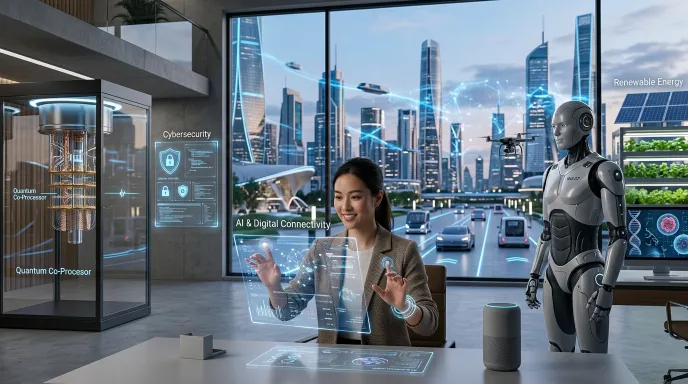
Technology has a strange habit of changing faster than we expect. A device that seemed revolutionary five years ago can suddenly feel outdated. A technology that once looked like science fiction can become something people use every day. Artificial intelligence is probably the clearest example. Just a few years ago, AI assistants were mostly a curiosity for technology enthusiasts. Today, millions of people use AI for writing, research, coding, design and everyday tasks. But AI isn’t the only technology worth watching. Robotics, quantum computing, cybersecurity, smart devices, biotechnology and new forms of digital infrastructure are also developing rapidly. So, what technologies could have the biggest impact in the years ahead? Here are 10 biggest technology trends shaping 2026 and beyond.
1. Artificial Intelligence Is Becoming More Powerful
It’s almost impossible to discuss the future of technology without talking about artificial intelligence.
AI is moving beyond simple chatbots.
Modern AI systems can help people write, analyze information, create images, generate software code, translate languages and automate complex workflows.
Businesses are also integrating AI into everyday operations.
A company might use AI to analyze customer feedback, automate routine support requests or help employees process large amounts of information.
The next stage of AI may be less about asking a chatbot a question and more about giving AI systems a task and allowing them to complete multiple steps.
This could fundamentally change how people interact with software.
2. AI Agents Could Change How We Use the Internet
One of the most interesting developments in AI is the rise of AI agents.
Traditional software usually waits for a human to tell it exactly what to do.
AI agents aim to go further.
You might give an AI a goal and allow it to plan several steps, use digital tools and work toward completing that task.
For example, instead of asking an AI to write a travel itinerary, future systems could potentially research destinations, compare options and organize the information into a complete plan.
This could make software feel much more like a personal digital assistant.
However, giving AI more autonomy also creates new questions about privacy, security and human control.
3. Humanoid Robots Are Moving Closer to Reality
Robots aren’t new.
Factories have been using industrial robots for decades.
What’s changing is the development of robots designed to operate in environments built for humans.
Humanoid robots could eventually assist with tasks such as:
- Manufacturing
- Warehousing
- Logistics
- Cleaning
- Elder care
- Hospitality
- Dangerous industrial work
The combination of advanced AI, better sensors and improved robotics hardware is making these machines increasingly capable.
The technology is still developing, and widespread household use isn’t guaranteed.
But humanoid robots are becoming one of the most closely watched areas of future technology.
4. Quantum Computing Is Moving Forward
Traditional computers process information using bits.
Quantum computers use quantum systems to perform certain types of calculations in fundamentally different ways.
That doesn’t mean quantum computers will replace ordinary laptops.
Instead, they could eventually be particularly useful for highly specialized problems.
Potential applications include:
- Drug discovery
- Materials science
- Complex optimization
- Cryptography
- Scientific research
- Financial modeling
Quantum computing remains a challenging field, and practical large-scale applications are still developing.
But its potential is enormous.
If researchers overcome major engineering challenges, quantum computing could transform areas of science that are currently extremely difficult to model.
5. Cybersecurity Will Become Even More Important
As technology becomes more connected, cybersecurity becomes more important.
We now store enormous amounts of personal and business information online.
That creates opportunities for criminals.
At the same time, AI is giving both cybersecurity professionals and attackers new capabilities.
Security teams can use AI to detect unusual activity and identify threats more quickly.
Attackers can also use automation and AI to make scams and attacks more sophisticated.
This means cybersecurity is likely to become one of the most important technology priorities for businesses and governments.
For ordinary internet users, basic security habits will remain essential:
- Use strong passwords.
- Enable two-factor authentication.
- Keep software updated.
- Be careful with suspicious links.
- Don’t share sensitive information unnecessarily.
6. Smart Devices Will Become More Connected
Smart technology is becoming increasingly common in homes, vehicles and workplaces.
Smart speakers were just the beginning.
Today, people can connect lights, cameras, thermostats, appliances, security systems and other devices.
The next step is making these devices work together more intelligently.
Instead of controlling every device individually, AI could help coordinate them according to your habits and preferences.
Imagine arriving home and having your lights, temperature and entertainment system automatically adjust to your usual routine.
That’s the broader vision behind the smart home.
7. AI-Powered Healthcare Will Continue to Grow
Healthcare is another field where technology could have a profound impact.
AI can help researchers and medical professionals analyze huge amounts of information.
Potential applications include:
- Medical imaging
- Drug discovery
- Disease research
- Patient monitoring
- Administrative automation
- Clinical decision support
Wearable devices are also collecting increasing amounts of health-related data.
Smartwatches and other devices can monitor things such as heart rate, movement and sleep patterns.
The challenge is making sure these technologies are accurate, secure and used responsibly.
Healthcare involves real human lives, so technology must complement professional medical judgment rather than blindly replace it.
8. Autonomous Vehicles and Smarter Transportation
The idea of self-driving cars has been around for years.
But autonomous transportation is about more than cars.
AI and advanced sensors could eventually transform:
- Public transportation
- Delivery services
- Logistics
- Warehouses
- Traffic management
- Agriculture
- Industrial transportation
Even if fully autonomous vehicles take longer to become mainstream than some predictions suggested, driver-assistance technologies are already changing the driving experience.
The long-term goal is a transportation system that is safer, more efficient and less dependent on human control.
9. Biotechnology and Personalized Medicine
Technology isn’t only changing computers.
It’s also changing biology.
Advances in biotechnology are helping scientists better understand diseases, genetics and biological processes.
One particularly interesting direction is personalized medicine.
Instead of treating every patient in exactly the same way, healthcare could increasingly use individual biological information to help determine which treatments are most appropriate.
AI can accelerate this research by analyzing enormous datasets and identifying patterns that humans might struggle to find.
The combination of biology and computing could become one of the most important technology developments of the coming decades.
10. Sustainable Technology Will Become More Important
Technology has helped create many modern conveniences, but it also consumes enormous amounts of energy and resources.
As the world becomes increasingly digital, the demand for electricity, computing power and infrastructure continues to grow.
That’s why sustainable technology is becoming increasingly important.
Areas to watch include:
- Renewable energy
- Battery technology
- Electric vehicles
- Energy-efficient computing
- Smart power grids
- Carbon reduction technology
- Sustainable manufacturing
The future of technology won’t only be about making things faster.
It will also be about making them more efficient.
Why These Technology Trends Matter
At first glance, technologies such as quantum computing and humanoid robots may seem unrelated to everyday life.
But major technological changes rarely stay inside laboratories forever.
The smartphone is a good example.
The technology behind modern smartphones required years of research in computing, telecommunications, batteries, sensors and software.
Eventually, those technologies came together in a device that became part of everyday life.
The same thing could happen with today’s emerging technologies.
Some will succeed.
Some will fail.
Others will evolve into something completely different from what we currently imagine.
Which Technology Will Have the Biggest Impact?
Artificial intelligence is currently the strongest candidate.
That’s because AI isn’t limited to one industry.
It can be applied to almost everything.
AI can help:
- Doctors
- Teachers
- Engineers
- Designers
- Programmers
- Researchers
- Business owners
- Students
- Content creators
But that doesn’t mean AI will be the only important technology.
The biggest changes may come from combinations of technologies.
For example:
AI + Robotics
could create more capable machines.
AI + Biotechnology
could accelerate medical research.
AI + Quantum Computing
could eventually help solve certain extremely complex problems.
AI + Smart Devices
could create more autonomous homes and workplaces.
The future may therefore be less about individual technologies and more about how they work together.
Will Technology Replace Human Jobs?
This is one of the biggest concerns surrounding technological progress.
Automation has already replaced some repetitive tasks.
AI could accelerate that trend.
But history shows that technology can also create entirely new industries and professions.
The important question may not be:
“Will technology eliminate jobs?”
Instead, we should ask:
“Which skills will become more valuable as technology changes?”
People who can communicate, think critically, solve problems, understand technology and adapt to change may be better positioned for the future.
Learning how to work with new technology could become just as important as traditional professional qualifications.
What Should You Learn in 2026?
You don’t need to learn every new technology.
That would be impossible.
Instead, focus on skills that are likely to remain useful across many industries.
AI Literacy
Understand what AI can and cannot do.
Critical Thinking
Learn how to question information and identify unreliable claims.
Digital Skills
Become comfortable with modern software and online tools.
Communication
Technology still cannot replace effective human communication.
Adaptability
The ability to learn something new may be one of the most valuable skills in a rapidly changing economy.
The Technology Race Is Just Beginning
The pace of technological development can sometimes feel overwhelming.
Every month seems to bring another AI model, robot, device or scientific breakthrough.
But technological progress isn’t always a straight line.
Some predictions will turn out to be wrong.
Some technologies will take much longer than expected.
And some inventions we haven’t even imagined yet could eventually become more important than today’s biggest trends.
That’s what makes the future so interesting.
Final Thoughts
The technology landscape of 2026 is changing rapidly.
Artificial intelligence is becoming more capable, robots are becoming smarter, quantum computing continues to develop, cybersecurity is becoming more important and biotechnology is opening new possibilities in medicine.
At the same time, smart devices, autonomous transportation and sustainable technology are changing the way we think about everyday life.
Nobody can predict exactly which technologies will dominate the next decade.
But one thing is clear:
The future will be shaped by technology—and by the people who learn how to use it.
For individuals and businesses, the smartest strategy isn’t to chase every trend.
It’s to understand the important ones, experiment with useful tools and remain ready to adapt.
Because in technology, today’s cutting-edge idea can become tomorrow’s everyday necessity.


[…] 10 Biggest Technology Trends That Will Shape the Future in 2026 […]