


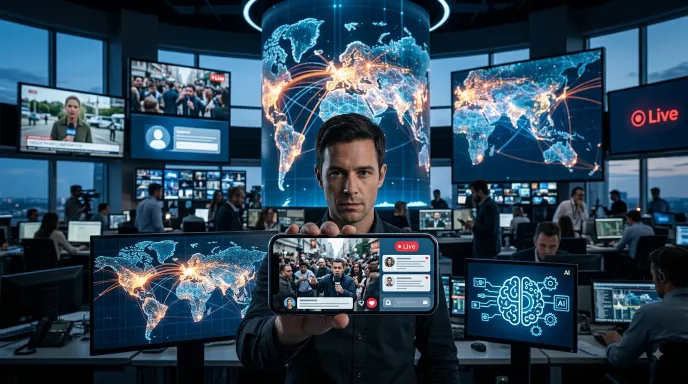
The way people receive breaking news has changed dramatically.
A major event that once took hours to reach television viewers or newspaper readers can now appear on millions of smartphones within seconds. A person standing at the scene can record a video, upload it to social media and potentially reach a global audience before traditional news organizations arrive.
This transformation has made news faster, more visual and more interactive.
But it has also created serious challenges.
Social media has made it easier for people to discover information, share eyewitness accounts and participate in public conversations. At the same time, misinformation, manipulated videos, AI-generated content and unverified claims can spread just as quickly.
The result is a completely new news environment where speed, reach and verification are constantly competing with one another.
The Rise of Social Media as a News Source
For decades, television, newspapers and radio were the primary ways people consumed breaking news.
The internet changed that model.
Then social media changed it again.
Platforms such as Facebook, YouTube, Instagram, TikTok and X have transformed news distribution into a continuous stream of short videos, posts, images, live broadcasts and discussions.
The Reuters Institute’s 2026 Digital News Report found that social media and video networks had become the most widely used way of accessing online news across its 48-market sample, used by 54% of respondents.
This represents a fundamental shift in how audiences discover news.
People increasingly encounter a news story while scrolling through their social feeds rather than intentionally visiting a newspaper or television news website.
Breaking News Can Now Happen in Real Time
One of the biggest advantages of social media is speed.
Imagine a major event happens in a city.
Within seconds:
- Someone records a video.
- The video is uploaded.
- Other users share it.
- People nearby provide additional information.
- News organizations notice the posts.
- Journalists begin verifying the claims.
- The story reaches audiences around the world.
This process can happen incredibly quickly.
Social media has therefore reduced the distance between an event and its audience.
The Rise of Citizen Journalism
Social media has also created a new form of public participation often described as citizen journalism.
Ordinary people can now document events using smartphones.
They may capture:
- Natural disasters
- Protests
- Sporting events
- Traffic accidents
- Political rallies
- Public emergencies
- Unexpected events
These eyewitness recordings can provide valuable information to professional journalists.
In some cases, the public may reach a location before traditional media crews.
However, citizen-generated content still needs verification.
A video showing a dramatic event may be authentic but incorrectly labeled with the wrong location or date.
That is why journalists increasingly need to verify the origin and context of social media content.
Social Media Has Made News More Visual
Traditional journalism was largely text-based.
Today, visual storytelling dominates online platforms.
Short videos, livestreams, photographs, infographics and animations can communicate information within seconds.
This has changed the way news organizations produce content.
Instead of simply publishing a 1,000-word article, a news organization may now create:
- A short video
- An infographic
- A live update
- A social media post
- A longer article
- An explainer video
The same story can therefore appear in multiple formats.
News Influencers Are Becoming More Important
Another major change is the growing role of individual creators.
People increasingly follow journalists, commentators, analysts and influencers directly.
Some creators have audiences larger than traditional media organizations.
This creates both opportunities and challenges.
Independent creators can explain complicated issues in simple language and reach audiences that traditional media may struggle to engage.
But creators may not always follow the same editorial standards as professional newsrooms.
A commentator can unintentionally present speculation as fact, especially when trying to publish quickly.
The Algorithm Decides What Many People See
Social media platforms do not simply display posts chronologically.
Algorithms help determine which content appears in users’ feeds.
These systems consider factors such as:
- Engagement
- Watch time
- Likes
- Comments
- Shares
- User interests
- Previous activity
This means emotionally powerful content can sometimes receive more visibility than carefully researched information.
The result is an important question:
Are people seeing the most important news—or simply the most engaging news?
The Problem of Misinformation
The biggest weakness of social-media-driven news is misinformation.
A false claim can spread rapidly because users may share it before checking whether it is true.
A 2026 Reuters Institute report found that 62% of respondents across its markets were concerned about fake news online, up four percentage points from the previous year.
UNESCO has also highlighted the growing challenge posed by misinformation and AI-generated deepfakes, noting that having more information available does not automatically guarantee better-quality or more accurate information.
This creates a serious problem for breaking news.
During the first minutes of a major event, information is often incomplete.
Early reports may later turn out to be wrong.
AI Is Making Verification Even More Difficult
Artificial intelligence is adding another layer of complexity.
AI can now generate highly realistic:
- Images
- Videos
- Audio
- Articles
- Social media posts
Some AI-generated content is clearly fictional or created for entertainment.
Other material can be deliberately designed to deceive.
The Reuters Institute has identified AI-generated content, deepfakes and misinformation as major challenges facing journalism in 2026.
This means journalists and readers increasingly need to ask:
Is this real?
Who created it?
Where did it first appear?
Can the original source be verified?
AI Is Also Changing Newsrooms
AI is not only creating problems for journalism.
It is also becoming a tool for journalists.
AI systems can assist with:
- Data analysis
- Transcription
- Translation
- Document analysis
- Research
- Monitoring social media
- Summarizing large datasets
- Identifying potential stories
Some emerging news operations are even experimenting with highly automated workflows in which AI agents discover, write, edit and publish stories. A recent WIRED report described one such AI-driven operation and the concerns surrounding speed, sourcing and human oversight.
This raises an important question for the future:
How much of journalism should be automated?
Speed vs Accuracy
The biggest challenge in modern breaking news may be the conflict between speed and accuracy.
Social media rewards being first.
Journalism traditionally rewards being correct.
These goals do not always align.
A social media account may publish a claim within seconds.
A professional newsroom may take longer because journalists need to:
- Contact sources
- Verify videos
- Confirm dates
- Check locations
- Compare reports
- Obtain official statements
The slower report may ultimately be more reliable.
This is why responsible news organizations should never sacrifice verification simply to win the race to publish.
Why People Still Need Professional Journalism
The rise of social media does not necessarily mean traditional journalism is disappearing.
Instead, the role of journalism is changing.
When everyone can publish information, professional journalists can provide something extremely valuable:
verification and context.
A journalist does more than tell readers that something happened.
Good journalism also asks:
- What happened?
- Why did it happen?
- Who is responsible?
- What evidence exists?
- What are the consequences?
- What remains unknown?
That context becomes especially important during chaotic breaking-news situations.
Social Media Can Also Strengthen Journalism
The relationship between social media and journalism is not entirely negative.
Social platforms can help journalists discover stories that might otherwise go unnoticed.
They can also:
- Reach new audiences
- Promote investigative journalism
- Allow direct communication with readers
- Provide eyewitness material
- Increase engagement
- Bring attention to underreported issues
Social media has therefore become both a distribution platform and a source of information.
The Future of Breaking News
The future of breaking news will likely be increasingly:
Instant
Visual
Mobile
Personalized
AI-assisted
Social-first
But there will also be a growing demand for trustworthy verification.
As AI-generated content becomes more realistic, audiences may increasingly value publishers that can demonstrate where information came from and how it was verified.
Trust could become one of the most valuable assets in digital journalism.
How Readers Can Verify Breaking News
Readers can protect themselves from misinformation by following a few simple principles.
Check the Source
Ask who originally published the information.
Look for Multiple Reports
If a major event is real, reputable independent sources will often begin reporting it.
Check the Date
Old photographs and videos are frequently reposted as if they are new.
Search for Official Statements
Government agencies, companies, sports organizations and other institutions may provide primary information.
Be Careful With Emotional Headlines
If a headline seems designed to make you angry or frightened, take a moment before sharing it.
Don’t Trust a Screenshot Alone
Screenshots can be edited or taken out of context.
What This Means for Viral Hive
For a digital publication such as Viral Hive, social media creates enormous opportunities.
A well-researched article can reach readers through:
- YouTube
- TikTok
- X
- Search engines
- News aggregators
But viral traffic should never come at the expense of credibility.
The strongest strategy is to combine:
Fast reporting + reliable sources + useful context + SEO + engaging presentation.
That combination can help a news website build long-term trust rather than relying only on temporary viral traffic.
Conclusion
Social media has permanently changed breaking news.
Events can now reach global audiences within seconds. Ordinary people can become eyewitness reporters. Journalists can discover stories through social platforms. News influencers can reach enormous audiences. AI can accelerate both news production and misinformation.
But speed alone does not make journalism valuable.
In an environment filled with rapidly changing information, the ability to verify facts, explain context and distinguish reality from manipulation may become more important than ever.
The future of breaking news will therefore not simply belong to whoever publishes first.
It may belong to whoever can be fast, accurate and trustworthy at the same time.
#SocialMedia #BreakingNews #DigitalJournalism #News #Journalism #CitizenJournalism #AI #Misinformation #DigitalMedia #NewsInfluencers #Technology #ViralHive


