


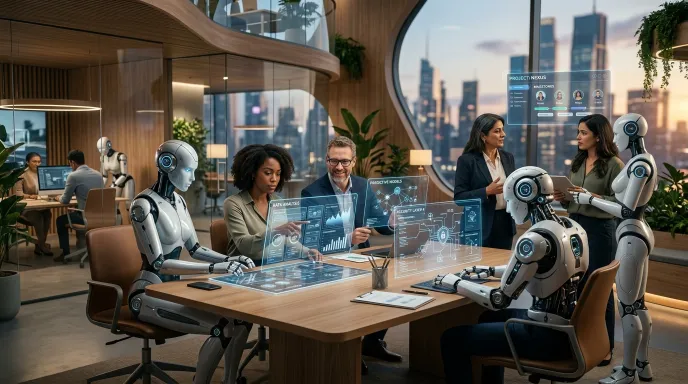
For decades, people have worried that technology would take away their jobs.
The concern isn’t new.
When machines entered factories, workers feared mass unemployment. When computers became common in offices, similar predictions appeared. And now artificial intelligence has brought the debate back in a much bigger way.
This time, however, something is different.
AI isn’t just performing physical tasks.
It can write, analyze documents, generate images, translate languages, create computer code, answer questions and handle many tasks that previously required human knowledge.
That raises an important question:
What will happen to jobs as AI and automation become more powerful?
The answer isn’t as simple as “AI will take everyone’s jobs.”
Some jobs will probably shrink. Some tasks will disappear. New careers will emerge. And many existing jobs will change rather than completely vanish.
By 2030, the workplace could look very different from the one we know today.
AI Is Changing Work Already
You don’t have to wait until 2030 to see the impact of AI.
It’s already happening.
Companies are using artificial intelligence for customer service, data analysis, marketing, software development, recruitment and administrative tasks.
Employees are also using AI tools to write emails, summarize meetings, generate ideas and analyze information.
For many workers, AI isn’t replacing them.
It’s becoming another tool they use during the workday.
Think about what happened when computers entered offices.
A computer didn’t necessarily eliminate the need for an accountant, journalist or designer.
Instead, it changed how those professionals worked.
AI could follow a similar path—but potentially at a much faster pace.
AI Will Replace Tasks Before It Replaces Entire Jobs
This is one of the most important things to understand about workplace automation.
A job is usually made up of many different tasks.
A marketing manager might:
- Research customers
- Write reports
- Analyze campaign results
- Attend meetings
- Create strategies
- Communicate with clients
- Review creative work
AI may be able to automate some of these tasks.
But that doesn’t necessarily mean the entire job disappears.
Instead, the person may spend less time on repetitive work and more time on strategy, communication and decision-making.
This is why the future of work is likely to involve job transformation, not simply job elimination.
Which Jobs Could Face the Biggest Changes?
Jobs involving highly repetitive and predictable tasks are likely to experience significant automation.
These may include areas such as:
Data Entry
AI systems can process and organize large amounts of structured information extremely quickly.
Basic Customer Support
AI chatbots can handle many routine questions without human intervention.
Routine Administrative Work
Scheduling, document processing and other repetitive office tasks can increasingly be automated.
Basic Content Production
AI can already generate simple descriptions, summaries and routine written material.
Certain Accounting Tasks
Some repetitive bookkeeping and data-processing activities can be automated.
Basic Translation
AI translation is becoming increasingly capable, especially for routine and commonly used languages.
But again, this doesn’t necessarily mean all workers in these professions will lose their jobs.
The nature of their work may simply change.
Jobs That Could Grow by 2030
While automation may reduce demand for certain tasks, technological change can also create new opportunities.
Some areas likely to remain important include:
AI and Machine Learning
As businesses adopt AI, they’ll need people who can build, manage, evaluate and implement these systems.
Cybersecurity
More digital systems mean more potential security risks.
Cybersecurity professionals will be needed to protect networks, businesses and personal information.
Healthcare
An aging population and advances in medical technology could increase demand for healthcare professionals.
AI may assist doctors and nurses, but human care and judgment remain extremely important.
Renewable Energy
The transition toward cleaner energy is creating demand for engineers, technicians and other specialists.
Robotics
As robots become more common in factories, warehouses and other environments, people will be needed to design, maintain and manage them.
Data Science
Organizations increasingly rely on data to make decisions.
Professionals who can understand and interpret that data may remain highly valuable.
Human Skills May Become More Valuable
Here’s something interesting about the AI revolution.
As machines become better at technical and repetitive tasks, uniquely human abilities may become more important.
These include:
Creativity
AI can generate content, but humans still provide goals, context, taste and original direction.
Communication
Explaining ideas clearly and understanding other people remain important in almost every profession.
Leadership
Organizations still need people who can motivate teams, make difficult decisions and take responsibility.
Critical Thinking
AI can produce convincing answers that are sometimes wrong.
People need to evaluate information rather than automatically accept it.
Emotional Intelligence
Understanding emotions and building relationships are difficult to reduce to simple automated tasks.
Adaptability
Perhaps the most important skill of all will be the ability to learn new things.
The Rise of AI-Assisted Workers
One possible future isn’t humans versus AI.
It’s humans working with AI.
Imagine a journalist who uses AI to organize thousands of documents but personally conducts interviews and verifies facts.
Imagine a doctor who uses AI to analyze medical images but still talks directly with patients.
Imagine a lawyer who uses AI to search through thousands of pages of legal documents before reviewing the most relevant material.
Imagine a programmer who uses AI to generate routine code while focusing on architecture and security.
In each example, AI doesn’t necessarily eliminate the professional.
It changes what the professional spends time doing.
Will AI Create More Jobs Than It Destroys?
Nobody knows the exact answer.
History suggests that technological revolutions can both destroy existing roles and create new industries.
The personal computer eliminated some types of office work but created entire industries around software, IT services and digital communications.
The internet transformed retail, media and advertising while creating careers that didn’t previously exist.
AI could follow a similar pattern.
We may eventually see jobs that sound strange today but become normal in the future.
Some possibilities could include:
- AI workflow specialists
- AI safety professionals
- AI trainers
- AI governance specialists
- Human-AI interaction designers
- Robotics technicians
- AI content editors
- Synthetic media specialists
Some of these roles already exist in early forms.
Others may evolve into completely different professions.
AI Could Make Small Businesses More Powerful
One of the less-discussed effects of AI is how it could help small businesses.
In the past, a small company might need separate employees for tasks such as:
- Content writing
- Graphic design
- Customer support
- Data analysis
- Marketing
- Research
AI can now assist with many of these activities.
That doesn’t mean one person can realistically do everything.
But a small team can potentially accomplish much more with the right technology.
This could lower some barriers to starting a business.
A freelancer with a laptop and a collection of AI tools may be able to provide services that once required a much larger operation.
Remote Work and AI Could Change the Workplace Again
Remote work has already changed how many people think about employment.
AI could accelerate that transformation.
If routine tasks can be automated and collaboration can happen digitally, companies may have more flexibility in how and where work gets done.
A business could potentially have employees in several countries while AI systems handle routine coordination and administrative work.
That creates opportunities—but also competition.
Workers may increasingly compete in a global labor market rather than only against people in their own city.
Education Will Need to Change
If AI can answer questions instantly, education can’t simply focus on memorizing information.
Students will need to learn how to:
- Ask better questions
- Evaluate sources
- Solve problems
- Think independently
- Communicate ideas
- Use AI responsibly
Schools and universities may increasingly focus on practical projects and critical thinking.
The goal shouldn’t be to teach students how to avoid AI.
It should be to teach them how to use it without losing their ability to think for themselves.
The AI Skills Gap Could Become a Major Issue
Not everyone will adapt to AI at the same speed.
Some workers will quickly learn new tools.
Others may struggle to understand how AI fits into their jobs.
This could create a skills gap.
Companies may need to invest more in employee training.
Workers may also need to take responsibility for continuously updating their skills.
The traditional idea of learning one profession and doing the same job for 30 years may become less common.
Instead, careers could involve continuous learning and repeated transitions.
What Should You Learn Now?
If you’re worried about the future of work, don’t panic.
Start by understanding AI.
You don’t necessarily need to become a programmer.
Learn how AI assistants work.
Understand their strengths and weaknesses.
Experiment with tools that are relevant to your profession.
For example:
Writer: Learn AI research and editing tools.
Designer: Learn AI-assisted design.
Marketer: Learn AI analytics and content tools.
Programmer: Learn AI coding assistants.
Business owner: Learn AI automation.
Student: Learn AI research and productivity tools.
The goal is not to become dependent on AI.
The goal is to become AI-capable.
Jobs AI May Struggle to Replace
Some occupations involve physical environments, human relationships or unpredictable situations.
These may be harder to fully automate.
Examples could include:
- Nurses
- Therapists
- Teachers
- Skilled tradespeople
- Emergency workers
- Construction professionals
- Social workers
- Leadership roles
- Certain creative professions
That doesn’t mean these jobs are completely protected from AI.
Technology can still change how these professionals work.
But full automation may be more difficult when a job requires empathy, physical adaptability, trust or complex human interaction.
The Most Valuable Worker of 2030?
It may not be the person who knows the most about AI.
It could be the person who knows how to combine AI with valuable human skills.
Imagine two employees.
One knows how to use AI but has poor judgment.
The other understands their industry, communicates well, thinks critically and knows how to use AI effectively.
The second employee is likely to be much more valuable.
AI skills alone aren’t enough.
Industry knowledge still matters.
Human judgment still matters.
Experience still matters.
The Future Won’t Be the Same for Everyone
The impact of AI will vary significantly by industry and country.
A technology company may automate tasks quickly.
A hospital may adopt AI more cautiously because of safety concerns.
A factory may use robots extensively.
A small local business may simply use AI for marketing and customer communication.
So there won’t be one universal “AI future.”
Different industries will change at different speeds.
What Will Work Look Like in 2030?
Nobody can predict it perfectly.
But we can imagine a workplace where:
- AI handles routine information processing.
- Robots handle certain physical tasks.
- Employees work with digital assistants.
- Meetings are automatically summarized.
- Software is increasingly generated with AI assistance.
- Businesses rely heavily on real-time data.
- Workers continuously learn new skills.
- Human judgment remains important for major decisions.
The workplace of 2030 may therefore feel less like humans competing with machines and more like humans managing teams of digital and physical tools.
The Biggest Risk Isn’t AI Itself
One of the biggest risks may be failing to adapt.
A worker who refuses to learn new tools could eventually find themselves competing against someone who can perform the same job more efficiently with AI.
Businesses face the same problem.
Companies that ignore technological change may struggle against competitors that embrace it.
That doesn’t mean everyone needs to adopt every new AI tool.
It means understanding what is changing—and deciding where technology actually provides value.
Final Thoughts
The future of work is already arriving.
AI and automation are changing how companies operate, how employees perform tasks and what skills employers value.
Some jobs will disappear.
Others will be transformed.
New careers will emerge.
And many workers will find themselves doing the same job in a completely different way.
The safest strategy isn’t trying to predict the exact job market of 2030.
It’s developing the ability to adapt.
Learn new technology.
Strengthen your communication skills.
Improve your critical thinking.
Understand your industry.
And learn how to use AI as a tool rather than seeing it only as a threat.
Because the future may not belong to humans or machines.
It may belong to people who know how to work effectively with machines.


