


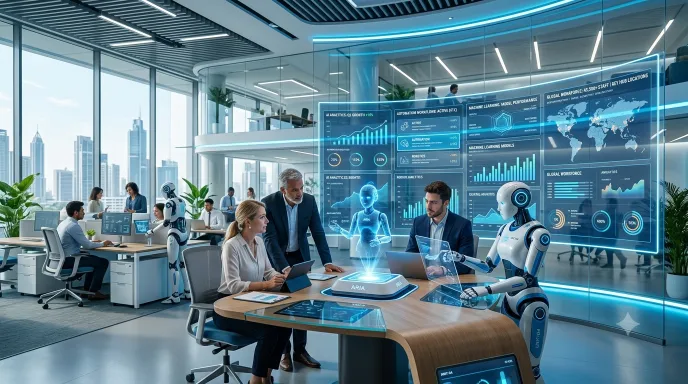
Artificial Intelligence (AI) has evolved from a futuristic idea to a potent force that is changing industries globally. In 2026, AI is advancing at an unprecedented pace, transforming the way businesses operate and changing the skills employers seek. From customer service and manufacturing to finance and healthcare, AI is automating repetitive tasks, improving efficiency, and helping companies reduce costs.
While AI creates exciting opportunities, it also raises concerns about job security. Many traditional roles are evolving or disappearing as intelligent software and machines become capable of performing tasks that once required human workers. At the same time, entirely new career paths are emerging for people who can work alongside AI.
This article explores why AI is replacing traditional jobs faster than expected in 2026, which industries are most affected, the careers that are growing, and how individuals can prepare for the future of work.
What Is Artificial Intelligence?
Artificial Intelligence refers to computer systems that can perform tasks requiring human intelligence. These include:
Learning from data
Solving problems
Understanding language
Recognizing images
Making predictions
Automating decisions
Modern AI systems have become increasingly capable due to improvements in computing power, cloud technology, and access to massive datasets.
Why AI Adoption Is Accelerating
Several factors are driving rapid AI adoption across industries.
- Lower Costs
AI software has become more affordable, allowing businesses of all sizes to automate routine work without making huge investments.
- Better Accuracy
Modern AI systems often analyze data faster and more accurately than humans, reducing costly mistakes.
- Increased Productivity
Employees can complete tasks more quickly when AI handles repetitive work such as data entry, scheduling, or document analysis.
- 24/7 Availability
Unlike human workers, AI systems can operate continuously without breaks, making them valuable for customer support, monitoring, and manufacturing.
- Global Competition
Businesses are adopting AI to stay competitive in an increasingly digital economy.
Industries Experiencing the Biggest Changes
Customer Service
AI chatbots and virtual assistants now answer common customer questions, process orders, and solve basic problems instantly.
Human agents increasingly focus on complex or sensitive cases that require empathy and critical thinking.
Manufacturing
Factories are using intelligent robots to assemble products, inspect quality, and manage inventory.
These systems work faster and with greater precision than traditional manufacturing methods.
Finance
Banks and financial institutions use AI to:
Detect fraud
Analyze investments
Assess credit risk
Automate customer support
Generate financial reports
Many repetitive office tasks have become largely automated.
Healthcare
AI assists doctors by analyzing medical images, predicting disease risks, organizing patient records, and supporting treatment decisions.
Rather than replacing healthcare professionals, AI helps improve speed and accuracy.
Retail
Retailers use AI for:
Demand forecasting
Personalized recommendations
Inventory management
Dynamic pricing
Automated checkout
These technologies improve customer experience while reducing operating costs.
Transportation
Self-driving technologies, intelligent logistics systems, and automated route planning continue to transform transportation and delivery services.
Jobs Most Likely to Be Automated
Some occupations involve repetitive, predictable tasks that AI performs efficiently.
Examples include:
Data entry clerks
Basic bookkeeping
Telemarketing
Cashiers
Customer support for simple inquiries
Appointment scheduling
Basic administrative assistants
Warehouse sorting
Routine quality inspection
Simple content generation
Automation does not necessarily eliminate every position immediately but often changes how these jobs are performed.
Jobs That AI Cannot Easily Replace
Despite rapid advances, many careers require human qualities that AI struggles to replicate.
Examples include:
Teachers
Nurses
Psychologists
Creative directors
Skilled trades
Scientists
Engineers
Entrepreneurs
Emergency responders
Leadership roles
Human creativity, empathy, ethics, communication, and strategic thinking remain highly valuable.
New Careers Created by AI
The AI revolution is creating demand for new professionals.
Growing careers include:
AI Engineer
Prompt Engineer
Machine Learning Specialist
AI Ethics Consultant
Data Scientist
Robotics Engineer
AI Product Manager
Cybersecurity Analyst
Cloud Engineer
AI Trainer
Many of these positions offer competitive salaries and strong long-term demand.
Skills That Will Matter Most
To remain competitive in an AI-driven economy, workers should develop both technical and human-centered skills.
Important skills include:
Technical Skills
AI literacy
Data analysis
Programming
Cloud computing
Cybersecurity
Digital marketing
Automation tools
Human Skills
Critical thinking
Communication
Creativity
Leadership
Emotional intelligence
Problem solving
Adaptability
Professionals who combine technical knowledge with interpersonal skills will be best positioned for future success.
How Businesses Benefit from AI
Organizations adopting AI often experience:
Lower operating costs
Faster decision-making
Improved customer satisfaction
Better data analysis
Increased productivity
Reduced human error
Enhanced security
These benefits explain why AI adoption continues to accelerate across industries.
Challenges of AI Adoption
Despite its advantages, AI also presents significant challenges.
Workforce Displacement
Some workers may lose jobs or need to transition into new roles.
Privacy Concerns
AI systems process enormous amounts of personal and business data.
Bias
Poor-quality training data can produce unfair or inaccurate decisions.
Cybersecurity Risks
Advanced AI tools may introduce new security threats if not properly managed.
Ethical Questions
Businesses and governments continue debating how AI should be regulated and used responsibly.
How Workers Can Prepare
Instead of fearing AI, professionals should focus on adapting.
Practical steps include:
Learn AI fundamentals.
Take online certification courses.
Improve digital skills.
Practice using AI productivity tools.
Strengthen communication and leadership abilities.
Stay updated on industry trends.
Build expertise that complements AI rather than competes with it.
Continuous learning will become one of the most valuable career strategies in the coming years.
The Future of Work
Experts increasingly believe that AI will transform jobs rather than eliminate all employment. Many roles will evolve as humans collaborate with intelligent systems.
Businesses will continue seeking workers who can:
Interpret AI-generated insights
Make strategic decisions
Solve complex problems
Build customer relationships
Innovate creatively
Conclusion
Artificial Intelligence is replacing certain traditional jobs faster than many experts predicted, but it is also creating new opportunities across nearly every industry. Rather than viewing AI solely as a threat, individuals and businesses should see it as a powerful tool for innovation and growth.
Workers who invest incontinuous learning, digital skills, creativity, and adaptability will be better prepared for the evolving job market. As AI becomes an integral part of daily work, success will depend not on competing against machines but on learning how to work effectively with them.


[…] Why AI Is Replacing Traditional Jobs Faster Than Expected in 2026 […]